

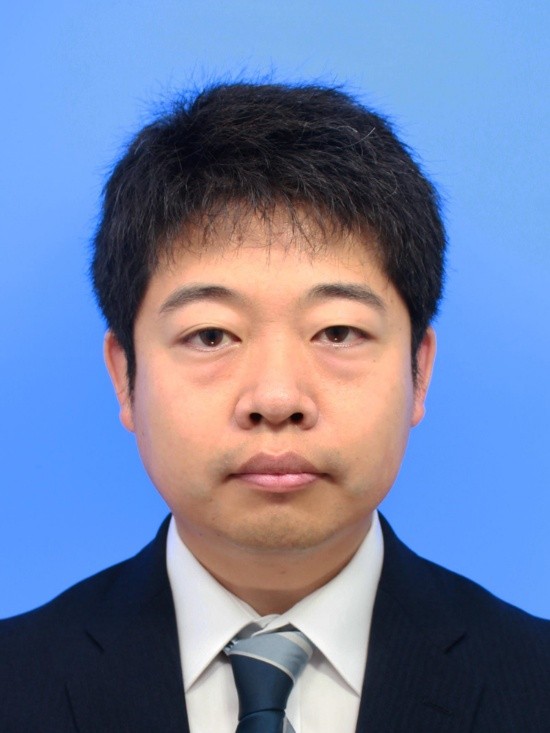
廣瀬 茂輝 准教授
Shigeki Hirose
専門分野
素粒子実験
宇宙の謎に素粒子で迫る
研究テーマ
エネルギーフロンティアでの新粒子探索 / ヒッグス精密測定 / 素粒子フレーバーを利用した間接探索 / 半導体技術による素粒子検出器の開発とその応用
キーワード
未知素粒子探索, ヒッグス粒子, タウレプトン, 半導体検出器
LINKS
RESEARCH OVERVIEW
研究概要
素粒子は、宇宙に存在するあらゆる物質の「素」です。したがって、その(特に、初期宇宙に近い、高エネルギーな状態での)性質の解明は、宇宙がどのように始まり、どう発展していったか?を実験室で探るということです。現在の素粒子標準模型は、17種類の素粒子と3つの力で構成された枠組みで、1970年代に完成しました。この理論は、その後数々の素粒子の存在や素粒子現象を予言し、非常に成功した理論ですが、一方で宇宙の物質生成や暗黒物質・暗黒エネルギーの存在を説明できない、重力が組み込まれていない等、明らかに不完全な理論であり、これは「究極の素粒子理論の低エネルギー近似」に過ぎないということも自明です。この、素粒子標準模型のほころびを掴むことが、現在の素粒子実験における最重要課題です。
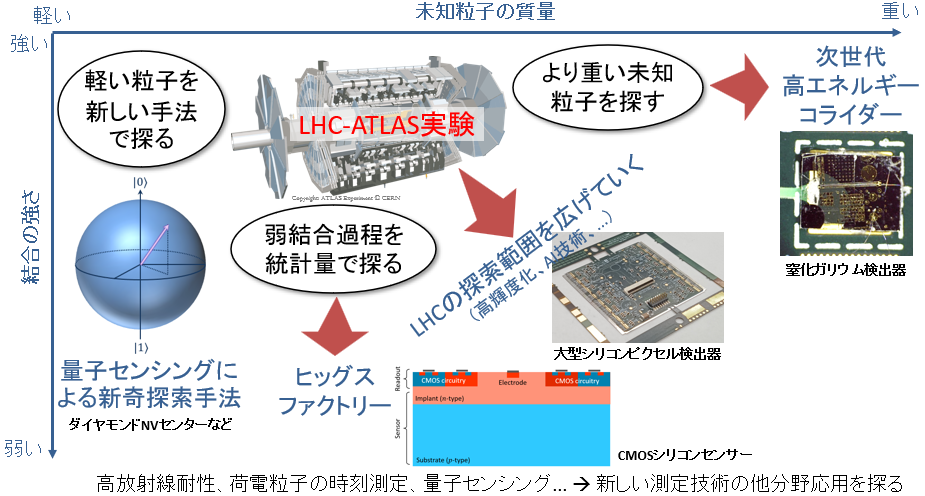
高エネルギーな素粒子現象を観測するには、どうしても大掛かりな実験装置が必要となり、したがってそれを実現するために世界中の研究者で協力して1つの実験を遂行します。スイス・CERN研究所の大型ハドロン衝突型加速器(Large Hadron Collider、LHC)は、世界で最も高い13.6 TeVでの衝突実験を行っていますが、本研究室ではこのLHCを用いた国際共同実験ATLASを、主な研究の舞台としています。本研究室では、特に
- ヒッグス粒子の性質を精密に測定することで、ヒッグス場とは何か?という謎に迫る。ヒッグス場は、素粒子質量を説明するためにかなり「強引」に導入された場です。
- 数TeV/c2の質量を持つ重い質量を発見し、標準模型の枠組みを超える「力」を特定する。
に着目していますが、ATLASの豊富なデータを使えば、アイデア次第でほかにも様々な物理研究が可能です。
素粒子の実験研究において、我々の「眼」である粒子検出器が欠かせません。本研究室では、特に半導体を使った新しい素粒子検出技術の開発にも挑戦します。この中では、既に基礎が確立されたシリコン検出器の技術の高度化に加え、窒化ガリウムなどシリコン以外の半導体を用いた荷電粒子センサーの開発や、半導体を量子センサーとして用いることで、これまでにない「眼」の獲得も目指していきます。このような新しい「眼」は、素粒子実験に限らず広く利用価値が高いものであり、これらの技術の他分野応用も積極的に検討していきます。
MESSAGE to STUDENTS
学生へのメッセージ
文字通り世界中の人々と協力しながら、素粒子の謎の解明に向けて挑戦的なデータ解析を進めたり、そのための実験装置を作り上げていったりすることが、素粒子実験の醍醐味だと思います。大型共同研究として進める中でも、物理学などの基礎知識をもとによく考え抜けば、自分のアイデアで面白い研究を実現することができます。学生の皆さん、一緒に「素粒子」という物質の究極の構成要素の真の姿を明らかにしていきましょう!
学歴・経歴
2011年 名古屋大学理学部物理学科 卒業
2017年 名古屋大学大学院理学研究科素粒子宇宙物理学専攻 博士後期課程修了 博士(理学)
2017年 ドイツ・フライブルク大学物理学科 研究員
2020年 筑波大学数理物質系物理学域 助教
2026年 早稲田大学先進理工学部物理学科 准教授
所属学協会
- 日本物理学会
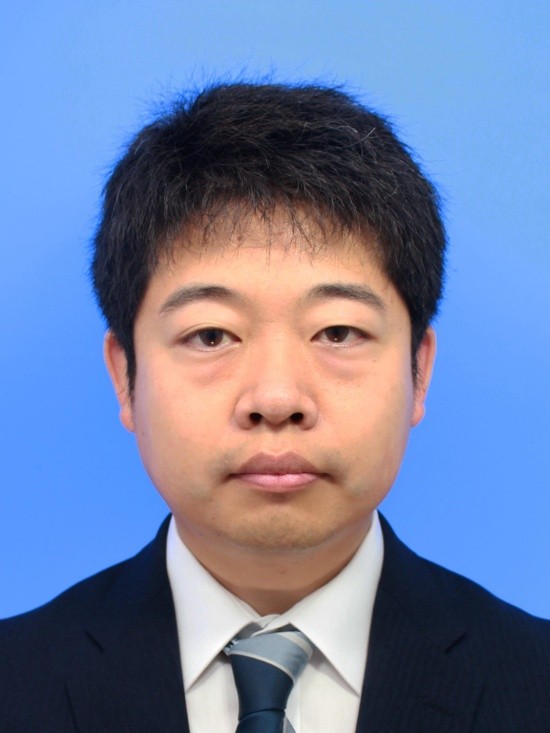
Shigeki Hirose
Associate Professor
Field of study
Particle Physics Experiment
Unraveling the Mysteries of the Universe with Particle Physics
Research Themes
New particle searches at the energy frontier / Precision Higgs measurements / Indirect new physics searches with particle flavours / Development of semiconductor-based particle detectors for next-generation experiments and applications
Keywords
New particle searches, Higgs boson, Tau lepton, Semiconductor detectors
RESEARCH OVERVIEW
Elementary particles are the most fundamental elements of all matters in the Universe. Therefore, elucidating their properties — especially under high-energy conditions like the early Universe — is essentially equivalent to experimentally exploring how the Universe began and how it has evolved. The current Standard Model of particle physics, completed in the 1970’s, is a framework consisting of 17 elementary particles and three fundamental forces. While it has been remarkably successful in predicting numerous particles and phenomena, it is clearly incomplete: it cannot explain the origin of matters in the Universe, nor the existence of dark matter and dark energy, and it does not incorporate gravity. It is therefore evident that the Standard Model is merely a low-energy approximation of a more fundamental, ultimate theory of elementary particles. Identifying the cracks in this framework is the central mission of contemporary experimental particle physicists.
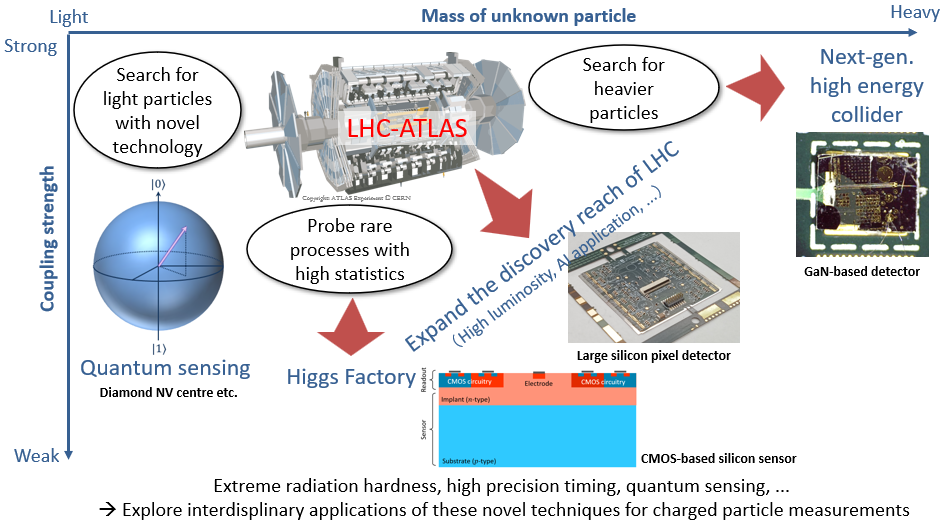
Observing particle interactions at high energy inevitably requires large-scale experimental facilities called an accelerator. As a result, such experiments are carried out through international collaborations involving researchers from around the world. The Large Hadron Collider (LHC) at CERN in Switzerland performs proton-proton collisions at the world’s highest energy of 13.6 TeV. Our group primarily conducts research within the ATLAS international collaboration at the LHC. In particular, we are interested in:
- Precisely measuring the properties of the Higgs boson to investigate the nature of the Higgs field, which was introduced — somewhat ad hoc — to explain the origin of particle masses.
- Discovering heavy particles with masses on the order of several TeV/c², thereby identifying new forces beyond the Standard Model framework.
At the same time, the vast dataset collected by ATLAS enables a wide range of other physics studies, depending on the ideas pursued.
In experimental particle physics, particle detectors act as our “eyes”. Our group is also engaged in the development of novel particle detection technologies, particularly those based on semiconductors. In addition to advancing well-established silicon detector technologies, we aim to develop charged-particle sensors using semiconductor materials other than silicon, such as gallium nitride, and to explore the use of semiconductors as quantum sensors to achieve entirely new forms of detection capability. These new “eyes” are expected to have broad applicability beyond particle physics, and we actively explore their use in other fields as well.
MESSAGE to STUDENTS
One of the greatest attractions of experimental particle physics is the opportunity to collaborate with researchers from all over the world to tackle challenging data analyses and build the gigantic and precise experimental apparatus needed to uncover the mysteries of elementary particles. Even within large-scale international collaborations, it is possible to realise original and exciting research ideas by thinking deeply and drawing on a solid foundation in physics and neighbour fields. If you are interested, why not join us to reveal the truth of nature of elementary particles — the ultimate building blocks of matter.
Education and Career
2011 Bachelor of Science, School of Science, Nagoya University
2017 Ph.D. in Science, Graduate School of Science, Nagoya University
2017 Postdoctoral Researcher, Institute of Physics, University of Freiburg, Germany
2020 Assistant Professor, Faculty of Pure and Applied Sciences, University of Tsukuba
2026 Associate Professor, School of Advanced Science and Engineering, Waseda University
Professional Memberships
- The Physical Society of Japan